


April 22, 2026, 12:52 p.m.
Do Socialismo Soviético ao Capitalismo Russo
Ateliê Editorial
Review
In 2017 I had the opportunity to attend a lecture by the author and FEA-USP professor Lenina Pomeranz on the Soviet economy, which sparked my interest in the subject and in this work. Having read it, I can say this is an excellent book and I feel even more motivated to learn about it — it was one of the seeds that drove me to pursue a second undergraduate degree in Economics.
The text has eight chapters divided into two parts:
1.1 – Historical Preliminaries to the Formation of the System
1.2 – The Formation and Configuration of the System
1.3 – The Mode of Operation of the System in its Evolution
1.4 – Perestroika and Glasnost: A Final Attempt at Building Socialism with a Human Face
1.5 – Summary Essay as a Contribution to the Assessment of the Historical Experience of Building Soviet Socialism
2.1 – The Construction of the New Capitalist Russia
2.2 – The Consolidation of the New Capitalist Russia
2.3 – Synthesis of the Process of Systemic Transformation
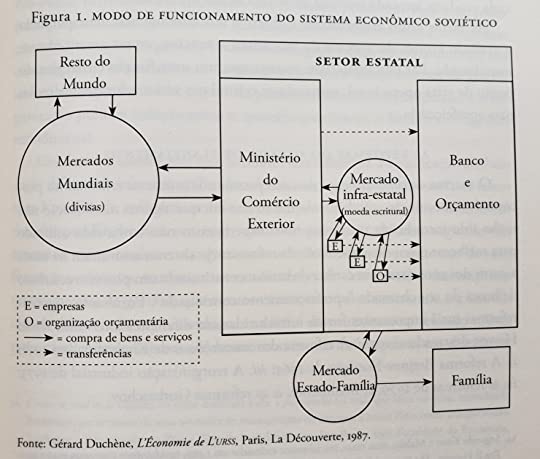
Up to the middle of the second chapter, which synthesizes and contextualizes events up to Lenin's government, the book will likely add relatively little to a reader already familiar with the Russian Revolution. From that point on, the book truly shows its greatest strengths, with a rich description of the workings of the Soviet economy and society, the internal ideological conflicts, and the various unsuccessful attempts at reforming the system until the end of the USSR in 1991.
The second part is dedicated to describing the complicated and turbulent events that followed Gorbachev's government — the mechanisms by which Russia instituted capitalism, the consequences of these transformations on civil society, and the interaction of political actors up to Putin's first government in the 2000s.
The writing has a typically academic style; it is not uncommon to feel as though one is reading a doctoral thesis. There is an attempt to present different interpretations found in the literature regarding the described events, as well as a clear rigor in grounding each idea in multiple sources and authors. Certainly one of the work's greatest merits lies in the richness of its use of Russian sources, which are directly inaccessible to most Brazilian readers. The short synthetic chapters at the end of each part are excellent additions — I will certainly miss something equivalent in other books, and they will be very useful for reviewing the content at a later time.
This book is an excellent result of solid research. I recommend it without hesitation to any reader interested in the workings of the Soviet Union, its collapse, and the rise of Putin's Russia.