


April 22, 2026, 12:52 p.m.
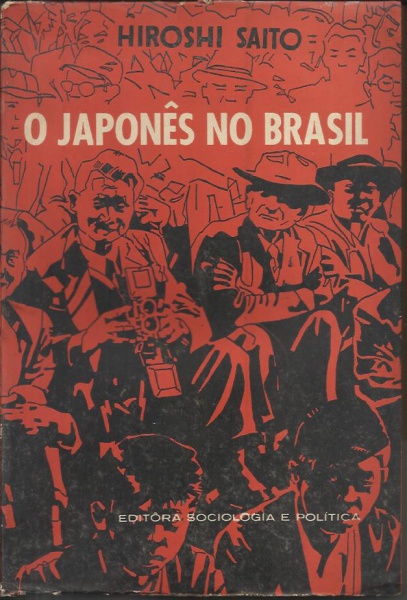
O Japonês no Brasil
Editora Sociologia e Política
Hiroshi Saito is considered one of the leading scholars of Japanese immigration of his era. He arrived in Brazil at age 14 in 1933 and, after living the life of a cotton farmer like many of his peers, moved to São Paulo and became a sociologist.
I had previously read another of his books, "A Presença Japonesa no Brasil" (The Japanese Presence in Brazil), in which he organizes the transcripts of a seminar on Japanese immigration. It consists of short articles covering less central topics, such as immigration to Tomé-Açu/PA (where the owner of the excellent Nipo-Paraense ramen restaurant in Saúde, Lamen-Açu, came from — worth mentioning), or comparative studies with immigration from other countries.
In this "O Japonês no Brasil" (The Japanese in Brazil), however, the concern is to describe and analyze the phenomenon of Japanese immigration in a more general and fundamental way: the circumstances in which they came, how many, at what ages, when, how they adapted, where they went, what they did, among other questions stemming from the subject.
It is a very descriptive book, full of interesting information I had no idea about — some extremely granular. For example, it includes a survey on dietary preferences in relation to Brazilian cuisine.
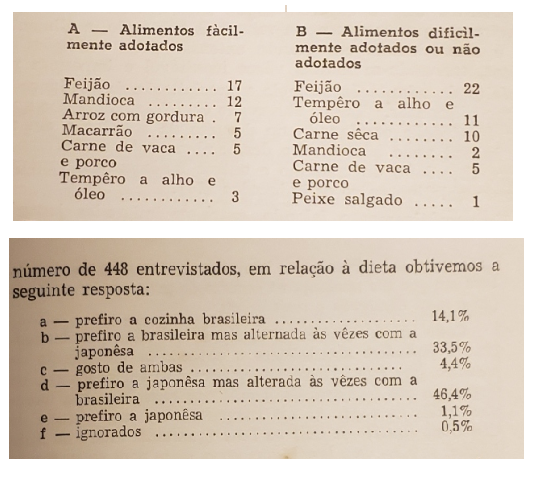
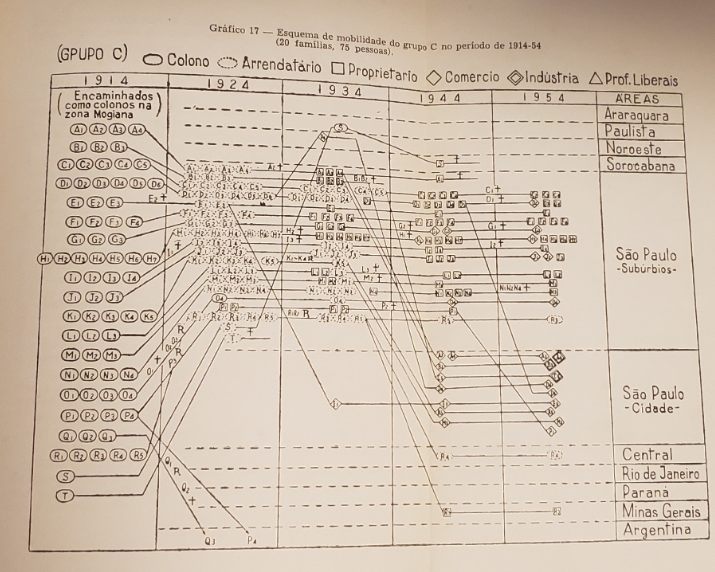
There are also graphs describing the geography of hierarchies around the dinner table among the Japanese (who sits where), or — my favorite — a complex chart detailing the occupation and place of residence of dozens of individuals, one by one, across the decades.
Written in 1961, this is clearly a book that does not cover the more recent half of the immigration story and its descendants, and I suspect some of Hiroshi Saito's analyses would be challenged by contemporary sociologists. For a more complete picture, a work such as "Imigrantes Japoneses no Brasil" (Japanese Immigrants in Brazil), published by EDUSP in 2010, might be recommended. Nevertheless, the richness of detail and description made me greatly appreciate this work — it seemed an excellent starting point for reading more on the subject.